
Building a SaaS product has become faster, but that doesn’t mean the process has become safer. Many products get built, tested, and even launched, yet fail before gaining traction in the market. In most cases, the problem isn’t the technology—it’s the lack of structured planning before execution.
It’s common for companies to use the Business Model Canvas to visualize business models. It’s an important tool, but it doesn’t work as well when applied directly to SaaS. SaaS products have their own challenges—recurring revenue, scalability, customer acquisition and retention, pricing, and continuous evolution. These factors require a different build logic than the one used for traditional businesses.
Without an adequate structure, the risk is building a great solution for a poorly defined problem—or for a market that can’t sustain the product.
Each field answers a strategic question
In a SaaS context, it’s not enough to fill in fields in isolation. Each block exists to answer a strategic question, and those questions must be answered in the right order.
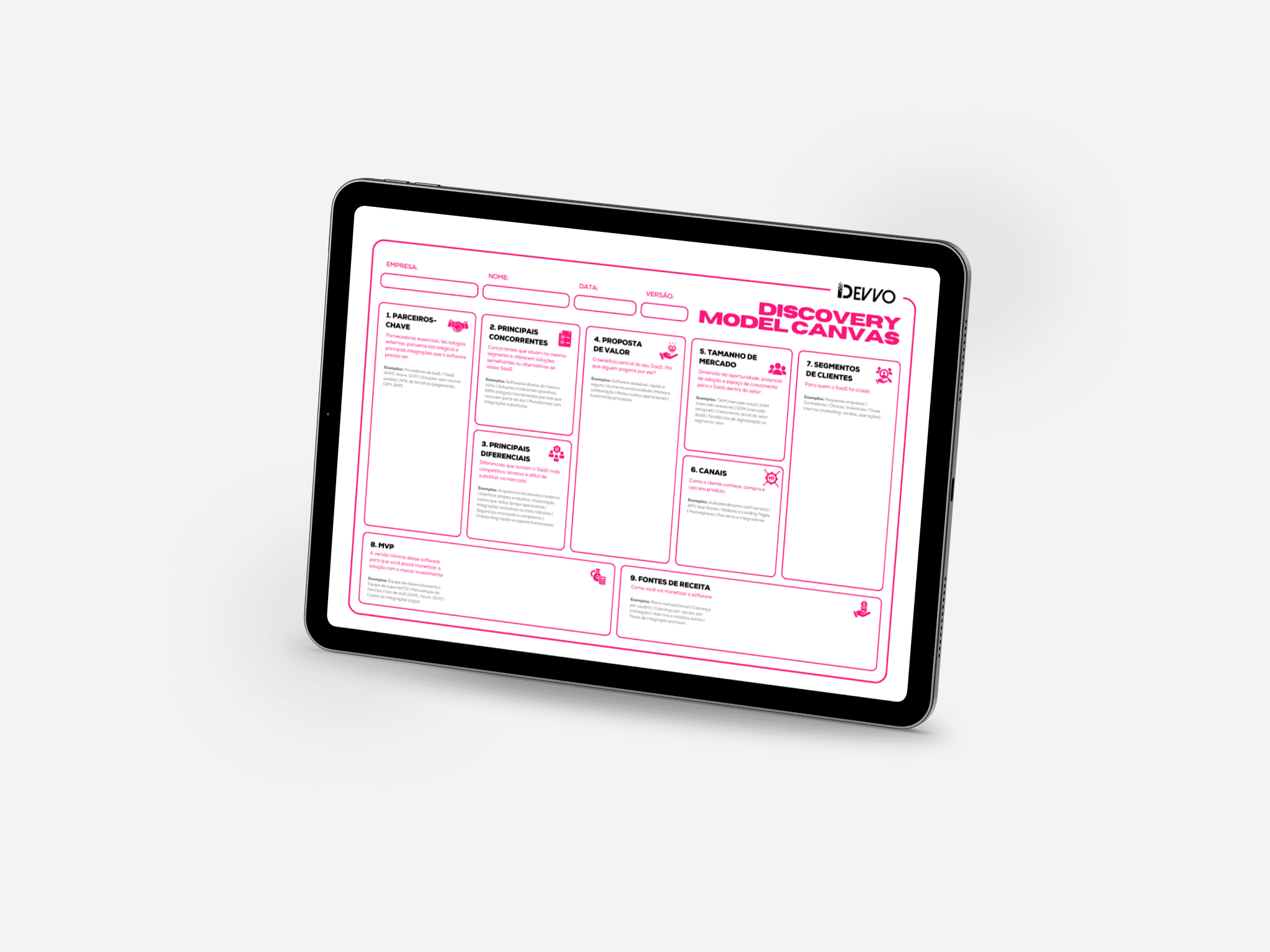
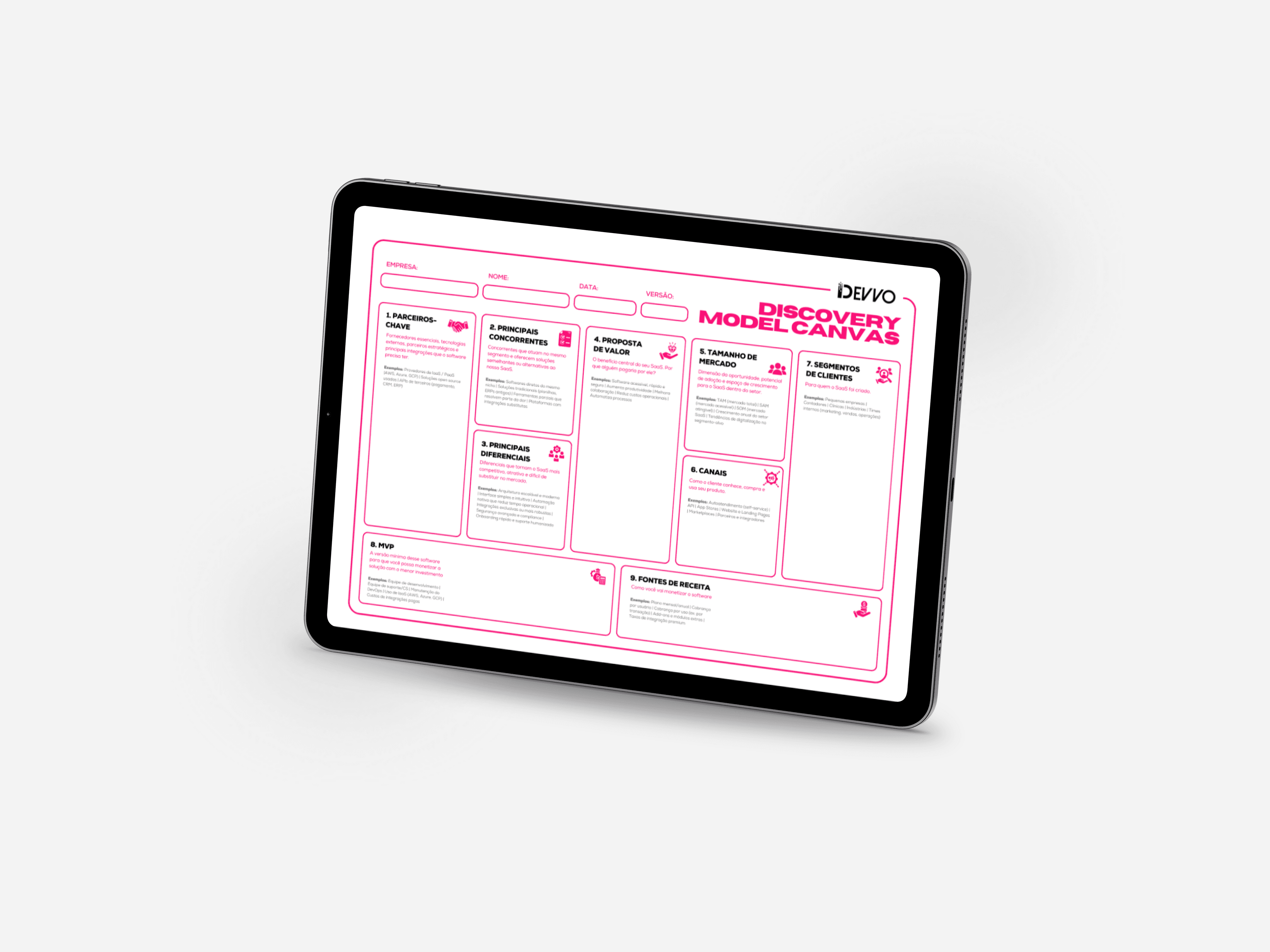
That’s why Devvo designed the Discovery Model Canvas for SaaS—a model based on the traditional Canvas, but organized to support decisions before execution.
The main difference is the starting point. The filling process begins with context, not the solution.
The filling order reflects the logic of a viable SaaS
Having a good solution is not enough if there’s no market, clear differentiators, or defined channels. The Canvas filling order follows the real logic of building a sustainable SaaS.
1. Key partners
The first step is understanding who the SaaS depends on to exist. This includes essential suppliers, external technologies, integrations, platforms, and strategic partners. This field helps anticipate risks, costs, and dependencies from the start.
2. Main competitors
Here the focus is identifying who already solves the same pain in the market. Not only direct competitors, but also alternative and substitute solutions. This analysis prevents creating a product disconnected from market reality.
3. Key differentiators
After mapping the competitive landscape, it’s necessary to define what truly differentiates the SaaS. Differentiators are not just features. They are factors that make the product more attractive and harder to replace.
These first three fields help you understand the environment where the SaaS will exist. They show what the product depends on, what it competes against, and what truly differentiates it.
Connecting problem, value, and opportunity
Only after understanding the context does the Canvas move forward to the value delivered by the product.
4. Value proposition
This field defines what problem the SaaS solves and why that matters to the customer. The central question here is simple: what benefit would someone be willing to pay to receive?
5. Market size
A strong value proposition only holds if there is a market with adoption and growth potential. This field sizes the opportunity and helps assess whether the effort to build makes sense.
Without this clarity, the product may work technically, but it’s unlikely to be sustainable.
Aligning acquisition, usage, and experience from the start
Another common SaaS mistake is treating marketing, product, and sales as separate stages.
6. Channels
This is where you define how the customer discovers, buys, and uses the product. This field connects acquisition, distribution, and the usage experience.
7. Customer segments
Defines who the SaaS is built for: who has the pain, who makes the buying decision, and who uses the product. Filling these fields correctly prevents disconnected decisions across the involved teams.
Turning strategy into conscious execution
Only after the entire context is defined does the Canvas reach execution.
8. MVP
The MVP represents the minimum version of the product needed to validate the value proposition and start monetizing with the lowest possible investment. The focus here is not to build everything, but to build what’s essential.
9. Revenue streams
Finally, you define how the SaaS will generate revenue: recurring plans, usage-based billing, add-ons, or other models. When this field is filled last, it connects directly to perceived value and the market defined earlier.
When these fields are filled without context, the risk is building something quickly that won’t hold up.
More than filling fields, it’s about making better decisions
Correctly completing the SaaS Business Model Canvas turns hypotheses into clear direction. The goal isn’t just to complete a framework—it’s to make better decisions before executing.
That’s how you avoid investing time and resources into the wrong product.