

If you want to know how to launch a SaaS with less risk, the answer starts before the code: understand what the product depends on, who it competes with, what sets it apart, who it is for and how it will generate revenue. Building got faster with today's tools. Launching is still risky. Many products that never take off had working technology and a poorly defined problem, a market that was too small or a sales channel nobody thought through.
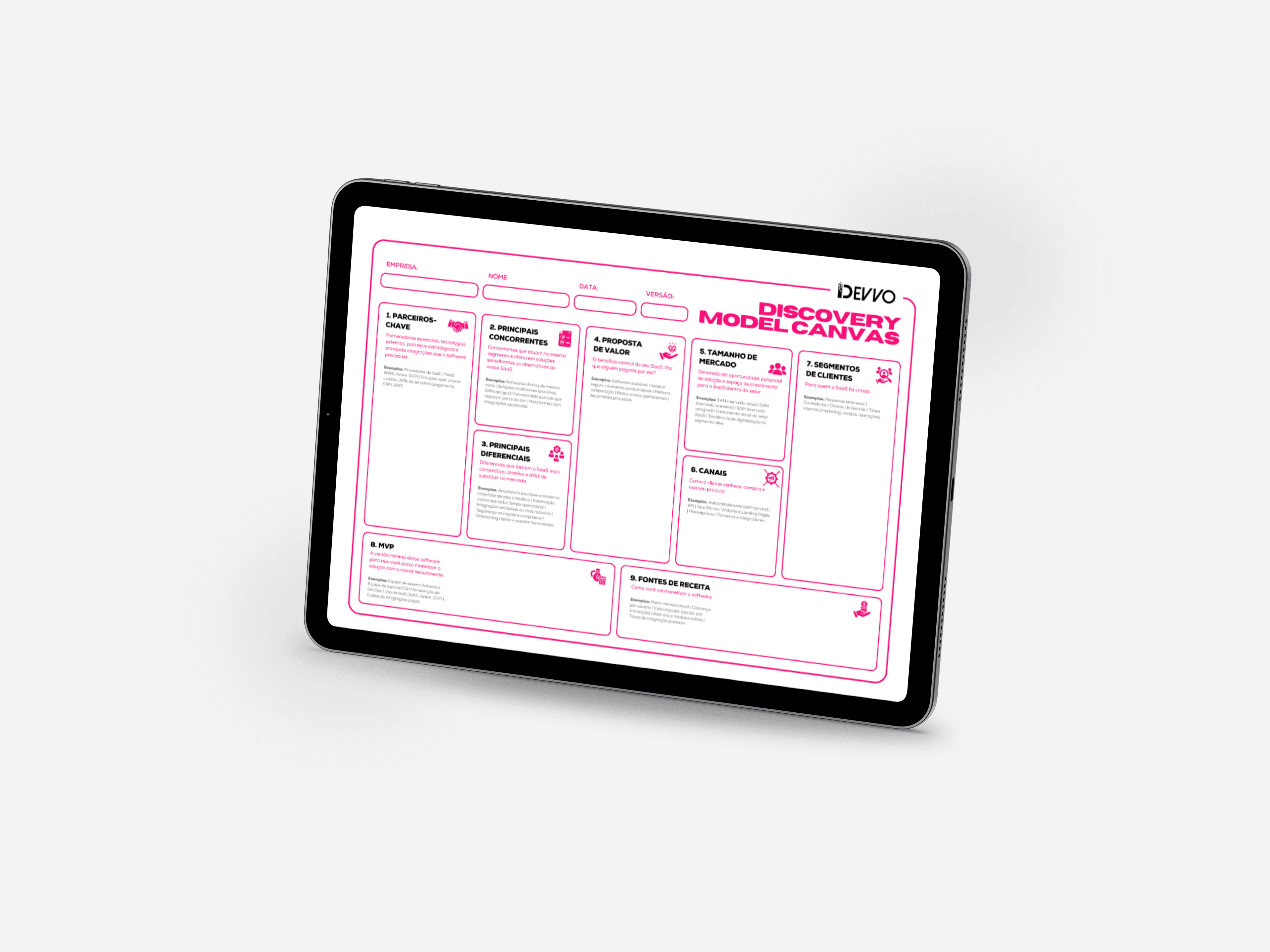
We organize this planning into a nine-question board, the Discovery Model Canvas for SaaS. Below, what each field answers, why the order matters and how to use the result to decide what goes into the MVP.
Why the Business Model Canvas is not enough for SaaS
The Business Model Canvas, created by Alexander Osterwalder, is one of the most widely used tools for laying out a business model on a single page. It works well for visualizing a business. For SaaS, it leaves out points that decide whether the product can sustain itself:
- Recurring revenue. The customer can cancel every month. Retention weighs as much as sales.
- Acquisition cost. How much it costs to bring in each customer, and how long it takes for that cost to pay back.
- Scale. The product has to serve the hundredth customer without costs growing at the same pace.
- Continuous evolution. The product is never finished. It needs a roadmap, a team and a budget after launch.
Without looking at these, the risk is building a good solution for a poorly defined problem or for a market that cannot sustain the product.
Order matters: context before solution
The main difference in our model is the starting point. Filling it in starts with context, and the solution only appears at the end. Whoever starts with the solution tends to defend an idea instead of testing it, and each following field becomes a justification for what was already decided.
The nine fields fall into four blocks.
Block 1: the environment the SaaS will live in
1. Key partners
What does the product depend on to exist? Infrastructure providers, third-party APIs, payment providers, platforms where it will run or be sold, commercial partners. This field anticipates risk and cost. A SaaS that depends on a single external API is exposed to any change in that API's price or rules.
2. Main competitors
Who already solves this pain today? This includes direct competitors and also the alternatives: spreadsheets, manual processes, a generic system adapted to the job, a dedicated employee. Often the biggest competitor of a new SaaS is the spreadsheet the customer already uses and has grown used to.
3. Main differentiators
After looking at the competitive landscape, what makes the product hard to replace? A differentiator is rarely a list of features, because features get copied. It usually lies in knowledge of a niche, an integration nobody else offers, a much better user experience or a lower cost for a specific profile.
These three fields show what the product depends on, who it competes with and what really sets it apart.
Block 2: problem, value and opportunity
4. Value proposition
What problem does the SaaS solve and why does it matter to the customer? The control question is direct: what benefit would someone pay for every month to keep receiving? If the answer is vague, the product is not clear yet.
5. Market size
A good value proposition only holds up with a large enough market. How many companies or people have this problem, how many can pay and how many can be reached through the available channels. This field tells you whether the building effort makes sense.
A product can work very well technically and still not sustain itself because the reachable market is too small.
Block 3: acquisition, usage and experience
A common mistake in SaaS is treating marketing, product and sales as separate stages, each decided by a different department at a different time.
6. Channels
How does the customer discover, buy and start using the product? Organic search, consultative sales, referrals, marketplaces, partners. The channel changes the product: a SaaS sold without a salesperson needs very simple sign-up and first use, while a SaaS sold consultatively needs guided onboarding.
7. Customer segments
Who was the product built for? It is worth separating three roles that are not always the same person: who feels the pain, who makes the purchase decision and who uses it day to day. In a mid-sized company, the CFO may approve, the analyst may use and the operations manager may feel the problem. Each one needs to see value for a different reason.
Block 4: from strategy to execution
8. MVP
Only with the context defined does the board reach the product. The MVP is the smallest version able to validate the value proposition and start charging, with the lowest possible investment. The right question is what needs to exist for the first customer to pay and keep paying. How many features fit in the timeline is the wrong question.
Building fast helps here. AI tools make it possible to put a prototype together in days. The care lies in what happens next, when that prototype receives real customer data, a topic we cover in our article on vibecoding and AI-built apps in production.
9. Revenue streams
Finally, how the SaaS generates revenue: monthly plans per user, usage-based billing, volume tiers, add-on modules, onboarding charged separately. Filled in last, this field rests on the perceived value and the market defined earlier, and becomes much easier to defend in a negotiation.
The whole board in one table
| Block | Field | Central question |
|---|---|---|
| Environment | Key partners | What do we depend on to exist? |
| Environment | Competitors | Who already solves this pain, and how? |
| Environment | Differentiators | Why would we be hard to replace? |
| Value | Value proposition | What benefit would someone pay for every month? |
| Value | Market size | Is there a reachable market that sustains the product? |
| Acquisition | Channels | How does the customer discover, buy and start using it? |
| Acquisition | Segments | Who feels the pain, who decides and who uses it? |
| Execution | MVP | What needs to exist for the first customer to pay? |
| Execution | Revenue | How do we charge in a way that tracks the value? |
How to use the board in practice
The board works best when it is filled in together, with people who know the customer, people who know the operation and people who will build the product. Alone, each one tends to see only their own part.
A few rules we follow:
- Every answer needs evidence. A customer conversation, market data, a partner contract. An answer that is only opinion gets marked as a hypothesis to test.
- An empty field is also information. If nobody can say who makes the purchase decision, that is the first job to do, before any screen.
- The board changes. After the first customer conversations, some fields will change. That is a sign it is working.
- One version per segment. If the product serves two very different audiences, it is worth building one board for each and choosing where to start.
Common launch mistakes
- Starting with the MVP. Without the earlier fields, the MVP becomes a wish list.
- Ignoring the spreadsheet as a competitor. Customers compare with what they already use, even if it is improvised.
- Setting the price before understanding value. The price comes from a cost calculation and ends up far from what the customer would accept to pay.
- Confusing the user with the buyer. The product pleases the people who use it and fails to convince the people who approve it.
- Launching and stopping. A SaaS with no roadmap loses customers to whoever keeps improving.
Before hiring development
With the board filled in, the conversation with whoever will build it moves up a level. Scope becomes clearer, proposals become comparable and it is easier to see who understood the problem. If the next step is choosing a vendor, our article on how to choose a software house helps compare proposals.
Filling in the board is about making better decisions before executing. It costs far less than finding out, after launch, that the product solved the wrong problem.